Monday, January 11, 2016

January Read Aloud

This month, our read aloud unit will be renamed, Interpretive Literacy. Through the use of complex texts, students will work in small groups with a teacher to practice the skills necessary to understand these challenging texts. This unit will focus on The Human Impact on Animals. This unit will incorporate skills and concepts covered across multiple subjects including; social studies, science, reading as well as mathematics through the use of complex texts.


What are complex texts?

Complex texts are literary and informational texts that include literary techniques that require a certain skill set in order for comprehension. Many of these texts are Non-Fiction, a genre that students aren’t as familiar or comfortable with as they are with fiction-genre texts.

Here is a list of the complex texts we will cover throughout this unit. Keep in mind that we will be spending multiple days on each text.

1)   “Animals in Crisis… Are People to Blame”
2)   “People Can Sicken Animals” by Amanda Leigh Mascarelli
3)   “Polar Bears in Danger”
4)   “Gorillas in Danger”

Students will learn to read a complex texts and identify difficulties. Some of which include:

·      Unknown words or phrases

·      Long, hard sentences

·      Figuring out who is telling the story or who wrote the text

·      Weird, short sentences

·      Weird punctuation in a sentence- hyphens or dashes

·      Abbreviations

·      Complex sentences that list 3 or more items with commas

·      Identifying cause and effect

·      Understanding the main idea of a poem

·      Figurative language: similes, metaphors

Students will practice these skills during the read aloud period with the teacher. Students will also be provided with a strategy chart, with examples included. This will allow them to apply these strategies to other texts.

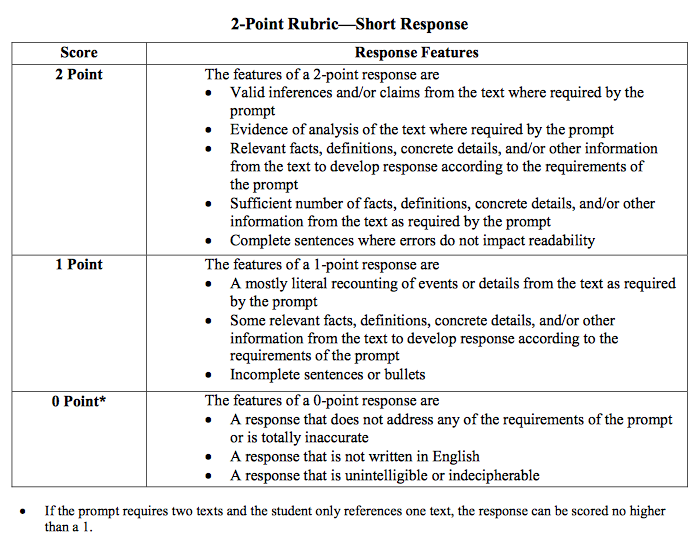
Through this unit teachers will also review the proper way to answer short response questions using details from the text. Your child will be expected to follow these guidelines to answer short response questions in class and for homework as well.

Below is the short response rubric we will utilize to assess the short responses from each text. This is the same rubric that the state will use when scoring the student’s test. Students have interpreted the rubric to make sense of it They each have a copy of the state rubric as well as the interpreted rubric.


Friday, January 8, 2016

January Writer's Workshop


Persuasive Essay 
Writing 


While children mature as writers, it's important to give them the opportunity to write using a variety of formats. Persuasive writing helps students formulate specific reasons for their opinions, and provides an opportunity to research facts related to their opinions. As students develop an understanding of how writing can influence or change another's thoughts or actions, they can begin to understand the persuasive ideas they are exposed to through television commercials, advertisements, the Internet, and other resources.


During this writing unit, we also guide students to analyze examples of persuasive writing and understand author’s purpose. Before writing a persuasive essay, students work on understanding how persuasion is used orally in everyday life by practicing convincing speeches about something that is important to them.


Furthermore, students will be learning how to use specific text evidence to support their opinion about topics. Along with interviewing people about their topics and including direct dialogue from the interviewee to better support their idea. 

Wednesday, December 16, 2015

December Writing Workshop


Theme Essay Unit

The fourth grade students have been learning a lot about various big life topics and experiences that people will encounter throughout their lives. Some Big Life Topics that we are noticing pop up in our independent reading books and our read aloud books are:

Friendship
Fitting In
Families
Accepting Others
Accepting Yourself
Death
Loss
Siblings
Peer Pressure


In this writing unit, the students are working on noticing themes and or messages that can be interpreted about the Big Life Topics stated above. The theme essay will then convey the various themes they learned from the books that they read. In the essay, students will have to state the theme and use three pieces of text evidence to support their theme. 

Wednesday, December 9, 2015

December Events


December is an exciting month filled with lots of holiday joy! Please check out the special events our fourth grade is participating in this month.


December 16th @ 12:45PM- Nutrition and Movement Dress Rehearsal

December 17th @ 10AM- Nutrition and Movement Performance.  The entire Fourth Grade will be doing a performance about healthy eating and the importance of exercise.  Come join us and celebrate what we have learned!
**All students performing must wear all black, black pants (leggings, sweatpants, no jeans) and a black t-shirt for BOTH the dress rehearsal and performance.**

December 18th @ 8:40AM- Parents as Reading Partners- Come to school and read with your family.

December 23rd- Silly Day- Students are encouraged to wear pajamas with your favorite bedtime book!

December 24rd- Winter Recess Begins

Thursday, December 3, 2015

November / December Reading

November/December Reading Unit:

Identifying Themes


The goal of this unit is to help the students understand that comprehending books is not just about understanding the plot of the story, instead, comprehending books means thinking about the ideas within books.  We want to help kids become more thoughtful as they read, understanding tha books are about ideas.  We want readers to develop the habit of asking themselves:
  • What is this story really about?
  • What themes or messages are buried in the text?
  • What evidence to I have to support my thinking?
  • What lesson can I learn about life after reading this story?


To help the students throughout this process, they will be introduced to Big Life Topics.  BLTs are the general topics that show up in books.  Once we have identified the BLTs, we then begin the work of narrowing down themes.

Below you will see examples of the Big Life Topics we will be covering in class, and some of the possible themes that can be developed from these BLTs.


In order to develop our skills in developing themes, we will be reading a number of short stories together and having conversations geared towards identifying BLTs as well as the themes that show up across multiple texts.  Some of the texts we will be reading throughout this unit are:


November Math

November Math


This month, we will begin our unit of study in multiplication and division.  Students will build upon their knowledge of place value that they learned throughout the first unit, as well as use visual representations to solve multiplication and division problems with multi-digit numbers.  As a key area of focus for fourth grade, this module works to develop students ability to reason about the methods and models chosen to solve problems with multi-digit factors and dividends.  

Students will begin by investigating formulas for area and perimeter.  They will then move on to using number discs and the place value chart to multiply single digit numbers by multiples of 10, 100 and 1,000.  Later, they will be able to multiply two digit multiples of ten by each other.  The students will be exposed to further practice with place value charts and area models.  See below for an example of each:


Solving a multiplication problem using a place value chart:


Solving a multiplication problem using area model:


New or Recently Introduced Vocabulary for this unit:
  • Associative property 
  • Composite Number
  • Distributive property
  • Divisor
  • Partial Product
  • Prime Number
  • Remainder
Familiar terms:
  • Area
  • Bundling
  • Compare
  • Factors
  • Multiple
  • Perimeter
  • Product
  • Quotient 


Sunday, November 8, 2015

November/December Social Studies


In November, we will begin a mini-unit focused on The Age of Exploration and European Explorers. During this unit, students will learn about various different European Explorers. Students will research different explorers by reading non-fiction texts. The goal of this unit is for students to understand why people in Europe began to explore territories across the globe and for students to recognize that the beginnings of our country are founded on the Age of Exploration. The purpose of this unit is to prepare students for the following unit, Colonial Life in North America. 


Starting at the end of November, we will begin our Colonial unit. During this time, students will learn about why people settled in the American colonies and how they survived in a new land. Using both primary and secondary resources, students will develop an understanding for what life was like for people living in the American Colonies. As the unit continues, we will begin to focus on Colonial life in New York State and how this would eventually lead to the development of New York today. 
The unit will last approximately one month and will end with a culminating research project. Working in the classroom, students will choose topic to research and will learn how to use non-fiction texts and Internet resources to carry out their research. Using the information they gather, students will develop a generalization, or big idea, about what life was like during Colonial times (Ex: During Colonial times, children had more responsibilities than they do today). Students will then use their research findings to develop three reasons that support their generalization. Students will also be required to prove that their reasons are true by using facts taken from the non-fiction resources they used during their research. Students will present their projects in the form of three short paragraphs and sketches that depict their research findings. 


Students may also continue their research at home by using our class website: http://www.portaportal.com/ Students may scroll down to the Social Studies section of the website in order to help with their research. See login information below:

Username: 4302

Password: ps172